If you have felt a creeping sense of obsolescence lately—a low-level panic that the tech world is accelerating faster than your ability to read, let alone understand—you received definitive validation today.
Andrej Karpathy, one of the architects of the modern AI landscape, tweeted that he has “never felt this much behind as a programmer.”
He described the profession undergoing a “dramatic refactoring,” where human contributions are increasingly “sparse.” He listed the new stack of anxieties programmers are expected to master:
 "agents, subagents, prompts, contexts, memory, modes, permissions, tools,"

"plugins, skills, hooks, MCP, LSP, slash commands, workflows..."Karpathy calls this a “magnitude 9 earthquake rocking the profession,” and describes working with AI as trying to wield an “alien tool” with no manual. His advice?
"Roll up your sleeves to not fall behind."When one of the smartest people in the room admits they are drowning in the noise, it’s not a skill issue. It’s an environmental hazard.
But his advice—to just try harder—is dangerous.If you look at that list of mechanisms and try to “roll up your sleeves” to master all of them simultaneously, you won’t catch up. You will burn out. You will spend your days doom-scrolling X, terrified by the volume of new releases, paralyzed by “Competence Anxiety.”
We need a different approach to the earthquake.
The Asymmetry of Noise
The anxiety you feel is based on a category error. You are trying to measure a biological process (Human Understanding) against a synthetic metric (Machine Generation).
The machine’s strength is infinite generation. It can produce new papers, new models, and new repositories every second. Your strength is finite attention.
When you open your feed, you are pitting your finite attention against infinite generation. You will lose 100% of the time. The algorithmic feed is designed to make you feel obsolete every six hours because it has content, but absolutely no intent.
The Sparse Bit
Karpathy noted that the human bits in programming are becoming “increasingly sparse.” He meant this as a warning, but it is actually our salvation.
In economics, what is sparse is valuable.
In an ecosystem of infinite generation, the “sparse bit”—your Intent, your Ethics, your framing of the problem—becomes the most critical resource.
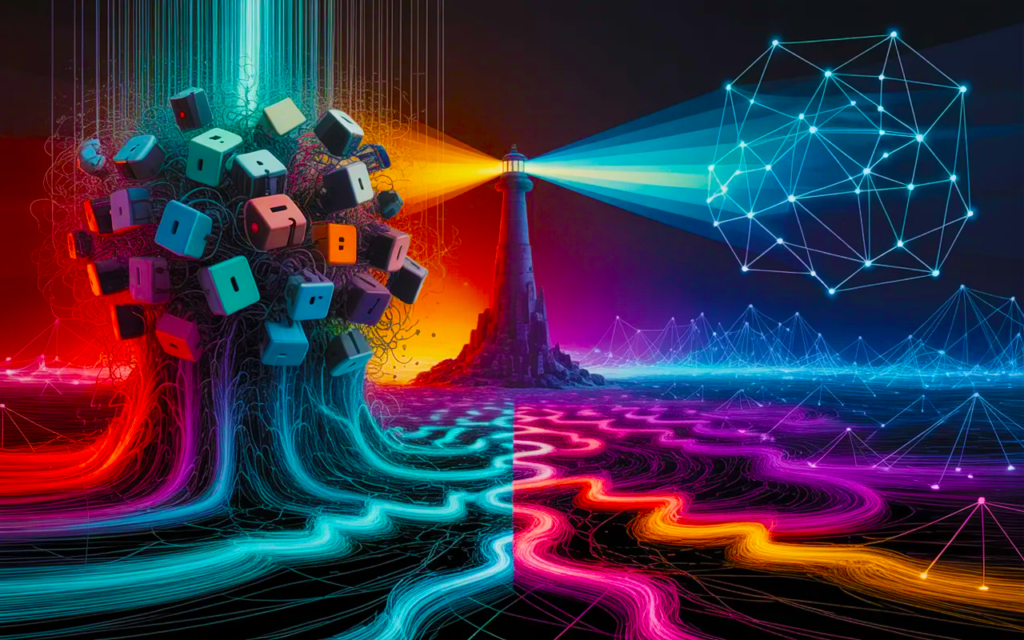
The “Alien Tool” has 10,000 horsepower, but it has no steering wheel. If you try to understand every component of the engine all at once, you’ll crash. Your job is no longer to build the engine; your job is to steer it.
The Shelter
We are undergoing a phase change from solid engineering (where things stayed written) to liquid engineering (where we guide stochastic, fallible entities on moving ground).
When the ground is moving that violently, trying to grip everything tighter is the wrong reflex.
The way to survive the "Magnitude 9 Earthquake" is not to try and hold the earth together.

It is to stand still and build one shelter.“Selective Ignorance” is no longer a weakness; it is your primary defense. You must shift from being a General Consumer (trying to know everything the feed throws at you) to a Specific Sovereign (deciding to know one thing right now).
Don’t try to master MCP, LSP, and agent memory today.
Instead, pick one atomic unit of value you want to create—one specific problem you want to solve. Close the tabs. Turn off the feed. Ignore the FOMO.
Use the alien tool to build just one “leaf.” Verify it. Understand it.
The earthquake will keep going outside. Let it. You are busy inside, building something real.
The Great Divergence
There is a darker implication to Karpathy’s warning that we usually miss.
When he says he feels “behind,” he is speaking from the perspective of the elite—the 0.1% who build the tools. But for the rest of the world, the danger is not “feeling behind.” It is losing agency entirely.
The gap between those who can absorb even 1% of this new technology and those who merely consume it is widening by the millisecond.
This is the math of the new era:
- The 1% (The Integrators): They struggle, yes. They feel the anxiety. But they hold the “Alien Tool.” Even if they only understand 1% of it, they possess a lever of infinite mechanical advantage. They can build, orchestrate, and define reality.
- The 99% (The Consumers): They do not hold the tool. They are held by it. The algorithm dictates their attention, their entertainment, and their truth. They are not the pilots; they are the passengers in a vehicle accelerating at Mach 10.
This is why “building your shelter” is not just a self-care tip. It is an act of defiance.
To stand still and build one concrete thing—to force the stochastic, alien entities to submit to your will and produce your vision—is the only way to remain on the sovereign side of the chasm.
If you stop building, you don’t just “fall behind” on your career path. You fall into the feed. You cease to be the Architect and become the User.
So, close the timeline. Ignore the noise. Build your leaf.
It is the only way to prove—to the machine and to yourself—that you are still driving.