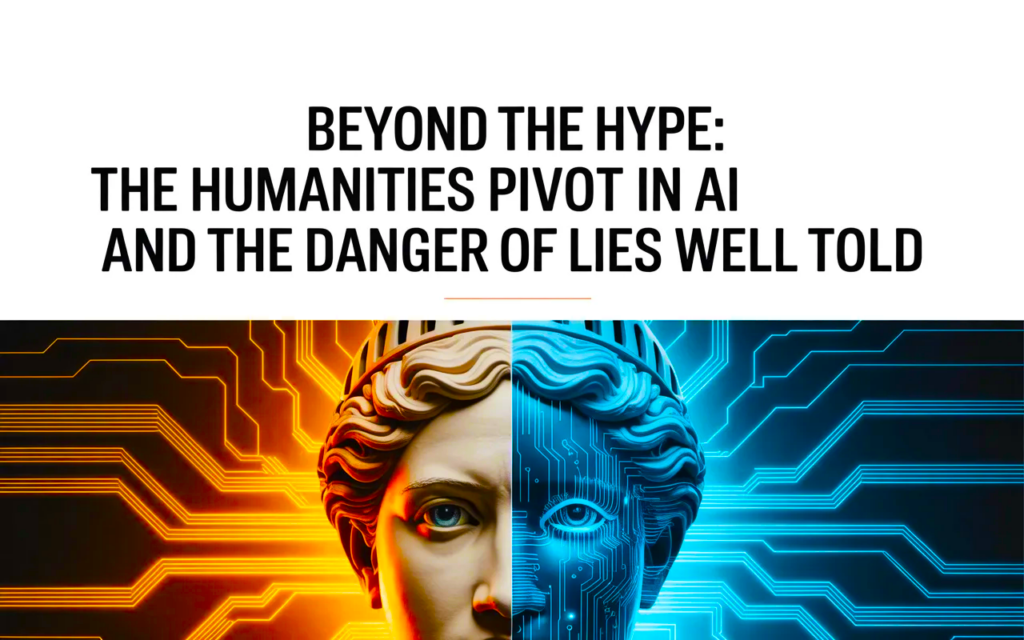
Anthropic’s Daniela Amodei says the future of AI hiring belongs to humanities majors with “soft skills.” She’s half right. The other half of that equation is where systemic risk lies.
When the co-founder of one of the world’s leading AI labs declares that the technical expertise needed to write code is in sharp decline, the industry listens. Daniela Amodei of Anthropic recently made waves by stating that the future belongs to humanities majors—people with high EQ, communication skills, and a grasp of nuance.
For many, this felt like vindication. The revenge of the English major. A definitive signal that the cold, hard reign of STEM is ending, replaced by a renaissance of human empathy in the machine age.
We ran this signal through our own rigorous framework. Initially, it looks like validation of our long-held belief that “context matters more than code.”
But if you strip away the philosophical romance and apply a cynical, structural “Rigor Check” to this pivot, a darker reality emerges. The shift toward “soft skills” isn’t just an enlightenment; it’s a necessary industrial correction that introduces a new, profound risk: The Fluency Trap.
Here is our detailed point of view on the rise of the “Humanities AI Operator.”
1. The Collapse of Syntax and the Rise of Arbitrage
First, let’s admit the obvious: Amodei is correct that the value of writing syntax is crashing toward zero. If you are a junior developer whose primary skill is remembering Java boilerplate, you are in trouble. The machine can do that faster, cheaper, and infinitely.
However, Anthropic’s pivot isn’t purely high-minded. It is also economic and practical.
- Wage Arbitrage: Engineering talent is scarce and expensive. Humanities talent is abundant and currently undervalued by the market. If an AI lab can prove that a model fine-tuned by 100 thoughtful writers outperforms a model tweaked by ten expensive engineers, they have successfully lowered their Cost of Goods Sold.
- Liability Management: When Amodei speaks of “kindness” in a corporate context, she is often speaking of safety alignment. Engineers build systems that execute. Humanities majors are being hired to build systems that don’t get sued. They are the new guardrails, tasked with policing tone to ensure the model doesn’t output toxic waste that tanks the stock price.
2. The “Truth Well Told” Paradox
In the 1980s, the legendary ad agency McCann Erickson used the slogan: “Truth Well Told.”

It was a brilliant encapsulation of advertising. You need a foundational reality (the product works), and you need a compelling narrative (the story sells it).
In the era of Generative AI, this concept has split apart disastrously.
- The AI has mastered the “Telling.” LLMs are fluency machines. They can generate persuasive, empathetic, and beautifully structured narratives on demand.
- The AI has not mastered the “Truth.” The model has no relationship with reality. It operates on probability, not epistemology. It doesn’t know if a database record exists; it only knows the statistical likelihood of the next token looking like a database record.
3. The Danger: Lies Well Well Badly Told
By prioritizing “humanities majors” and “soft skills” without a corresponding anchor in structural reality, the industry risks creating a generation of systems that are “Lies Well Told.”
This is the Fluency Trap.
A “humanities-first” AI approach might prioritize Rhetorical Integrity (Does this sound good? Is it kind?) over Epistemic Integrity (Is this actually true?).
If we over-index on “soft skills,” we get bots that can gaslight you with incredibly high EQ. A system that can apologize beautifully and empathetically for deleting your production database is still a failed system. In a production environment, eloquence is no substitute for accuracy.
4. The Solution: The Context Architect
The binary choice between “STEM Robot” and “Humanities Poet” is a false one. The future doesn’t belong to either exclusively.
The scarcity going forward is the Context Architect.
This is the hybrid operator who understands the human nuance required for the interface (L7) but possesses the rigorous understanding of the system’s structural constraints (L0 – Physics/Logic).
The Context Architect knows that “soft skills” in AI are actually structural constraints:
- Communication isn’t just chatting; it’s defining rigorous prompt protocols so the probabilistic machine behaves deterministically.
- Empathy isn’t just being nice; it’s understanding user latency tolerance and designing workflows that respect human time.
The Integrity Data Stance
We are moving from a “How-to” economy (STEM) to a “What-for” economy (Humanities). But if you only have the “What-for” without understanding the materials of construction, you are merely a dreamer.
While the market floods with “Prompt Poets” and “Vibe Managers” to handle the surface layer of AI interaction, we remain focused on the deep structure.
We need fewer people to write the code. We need more people with the integrity to audit the logic.
The AI provides the “Telling.” You must provide the “Truth.”