A Junior Dev with three AI agents just outpaced a 10-year veteran. The resulting economic shift is terrifying for buyers, but it’s the only way forward for true seniors.
The Incident
https://twitter.com/ujjwalscript/status/2010599605998895451
It happened last week. A moment that every senior developer has secretly feared since ChatGPT dropped in late 2022 finally arrived for Ujjwal Chadha.
Ujjwal is no slouch. He has a decade of experience. He’s mastered languages, optimized complex databases, and architected systems handling millions of requests. He is the definition of a “Senior Engineer.”
But last week, he was dusted by a Junior developer.
This Junior didn’t understand monolithic vs. microservice architecture. He couldn’t explain half the codebase he was working in. Yet, in four hours, he pushed a feature that Ujjwal admits would have taken him three days.
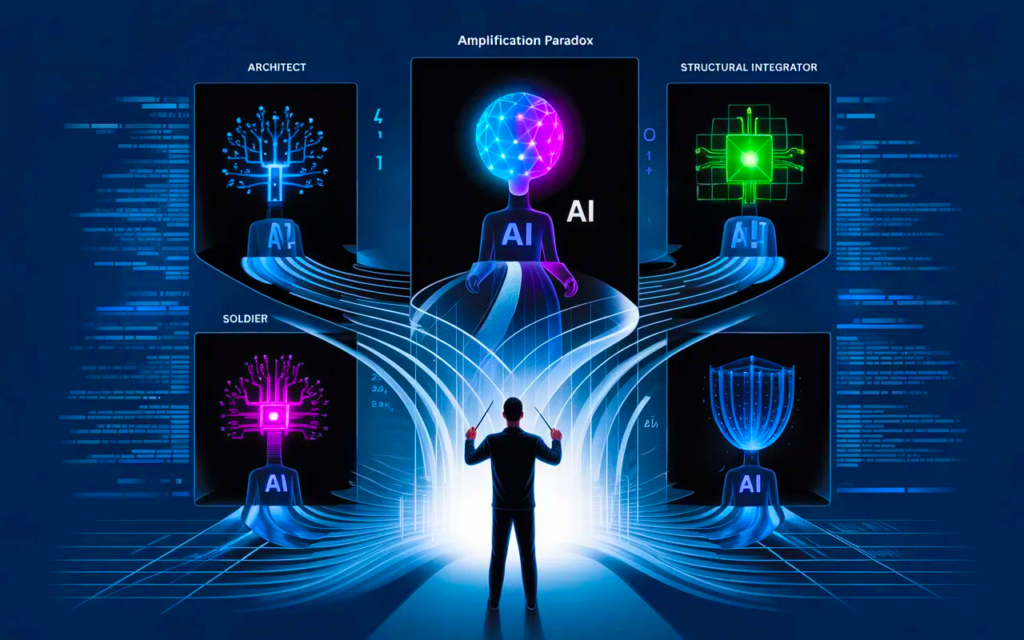
How? The Junior wasn’t coding; he was orchestrating. He managed three separate AI agents—one for frontend, one for backend logic, one for unit tests—treating them like tireless interns.
Ujjwal described the feeling perfectly: “I felt a cold shiver. ‘Is this it?’ I thought. ‘Am I finally the legacy hardware?'”
If velocity is the only metric, the Senior developer is obsolete. The machine, guided by even an inexperienced hand, is simply faster at generating syntax.
But then, Ujjwal looked at the Pull Request.
The “Fragile” Victory
The PR was fast. It was functional. The tests passed. The PM was thrilled.
But to Ujjwal’s experienced eye, it was terrifying.
“It was fragile,” he wrote. “It lacked architectural vision. It had security holes that only someone who has been ‘burned’ would see. It was a house built on sand.”
The Junior had successfully generated output, but he hadn’t generated a sustainable outcome. He had used AI to construct a beautiful facade with no load-bearing walls.
This moment highlights the defining schism of software development in 2026: The disconnect between Velocity (how fast it gets built) and Integrity (how long it lasts).
And this schism is about to create an economic nightmare.
The Economic Trap: The Market for Lemons
We must face the brutal implications of this scenario in the open market.
Imagine a typical non-technical buyer—a founder, a small business owner, a marketing director. They have a desperate need, limited budget, and zero technical knowledge.
The Buyer’s Perspective: They need the app “yesterday.” They cannot see code quality. They cannot see security vulnerabilities. They only see the “Submit” button working on the demo screen.
Now, two developers bid on the project:
- The AI-Powered Junior: Quotes $500 and delivery by tomorrow afternoon. (He will use agents to glue together a plausible-looking solution).
- The Wise Senior: Quotes $5,000 and delivery in two weeks. (She sees the hidden complexity, auth risks, and scaling issues, and plans to build it right).
In a market where the buyer cannot distinguish quality, the Junior wins that bid 100% of the time.
This is what economists call Akerlof’s “Market for Lemons.” When bad products cannot be distinguished from good products, the bad products drive the good ones out of the market because they are cheaper to produce.
The Era of Disposable Software and the “Sugar High”
We are entering the era of “Disposable Software.” The market is about to be flooded with visually complete but structurally rotten applications.
The buyers will get an immediate dopamine hit—a “sugar high” of fast delivery. The Junior gets paid. The AI agents spin down. Everyone declares victory.
Until six months later.
Until the user base hits 10,000 and the database locks up because the schema was designed by an LLM that didn’t understand indexing. Until a hacker finds the authentication bypass that the Junior didn’t recognize because he’s never handled JWTs before.
When the house built on sand collapses, the cheap speed of the Junior suddenly becomes the most expensive mistake the buyer ever made.
The Pivot: From Coder to Insurer
So, where does that leave the Senior Developer who feels like “legacy hardware”?
If you try to compete with AI-augmented Juniors on raw speed for greenfield projects, you will lose. You cannot type faster than three agents working in parallel.
As Ujjwal realized: “The ‘Senior’ title isn’t about how fast you type anymore. It’s about how well you judge.”
The role of the Senior Developer must pivot aggressively from Builder to Auditor, Architect, and Insurer.
Your value is no longer solely in writing the code; your value is in possessing the library of past failures—the “scars”—that allows you to look at AI-generated code and instantly spot where it will break in production.
AI models are predictive engines based on training data. They do not have “wisdom.” Wisdom is the visceral understanding of consequence, gained through experience.
The New Business Model: The “Rescue” Tier
Seniors need to change their pitch. Stop selling “clean code” to buyers who don’t know what that means. Start selling Risk Mitigation.
When that ignorant buyer is considering the Junior’s fast quote, your job isn’t to out-bid them. Your job is to say:
“They can build it by Tuesday. But when it crashes during your Black Friday sale because it wasn’t built for concurrency, it will cost you $50,000 in lost sales. I build it by next Friday, and I guarantee that won’t happen.”
You are no longer selling development; you are selling liability insurance.
The market is splitting into two distinct tiers:
- The “Vomit” Tier: Prototypes, internal tools, marketing throwaways. Let the Juniors and Agents have this high-velocity, low-stakes work.
- The “Rescue” Tier: High-stakes, mission-critical systems, and—most profitably—fixing the disasters created by Tier 1.
Writing the Symphony
Ujjwal’s analogy is perfect for 2026: “We are moving from being coders to composers. The machine can write the notes. Only you can write the symphony.”
The notes are syntax. They are cheap now. The symphony is the architecture, security, reliability, and long-term viability of the system. That is still rare, and therefore expensive.
If you are a veteran developer feeling the cold shiver of obsolescence, stop typing and start thinking. Don’t compete on speed. Compete on the one thing the machine—and its inexperienced operators—cannot replicate: Judgment.