A few days ago, Alex Karp went on CNBC and said something many serious businesses have already been thinking, even if they do not say it publicly.
They are paying for tokens. They are not always seeing enough value. And, more importantly, they are not fully comfortable with what may happen to their data, prompts, process knowledge, and competitive advantage once those assets pass through someone else’s AI infrastructure.
There was plenty of CNBC theater around the conversation. There was also the obvious Palantir self-interest. But underneath all of that, there was a serious architectural point that deserves attention:
The model is not the system.
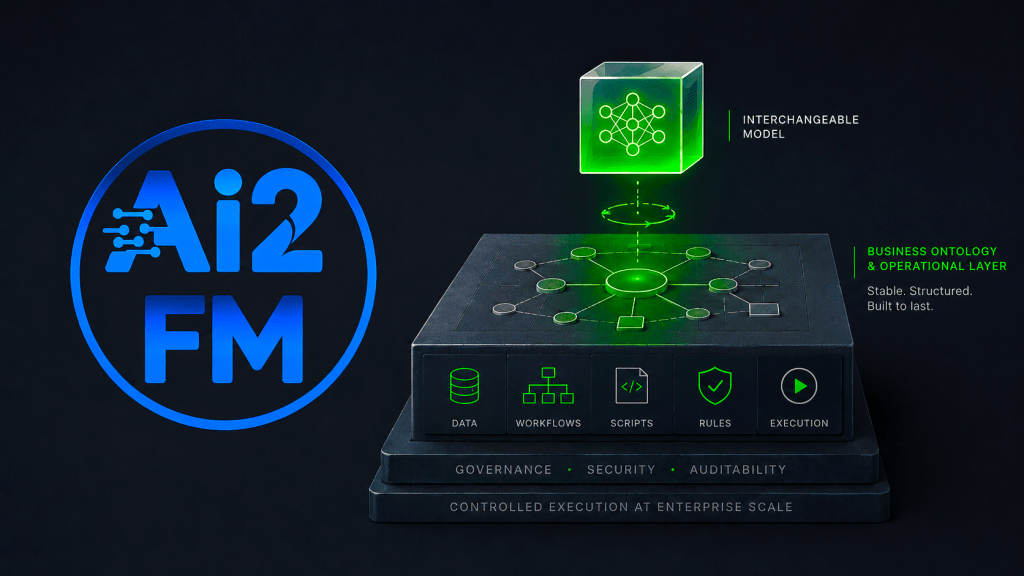
The model is only one component. A useful enterprise AI system is not built from a model alone. It needs an application layer, controlled compute, ownership of data, and clear operational boundaries. Without those pieces, AI remains impressive in demos but fragile in real business environments.
The Problem With Naked LLMs
Large language models are powerful, but power is not the same as understanding.
A generic model does not understand your company just because you gave it a prompt. It does not automatically understand your schema, your permissions, your workflows, your edge cases, your business rules, or the years of practical decisions hidden inside your system.
This matters because business language is never as simple as it looks.
When a user says, “save the record,” that sounds obvious. But in FileMaker, the actual operational meaning may be one of several different script steps, each with different behavior and consequences.
For example:
Commit Records/Requests [ With dialog: Off ]
is not the same as:
Commit Records/Requests [ With dialog: On ]
To a generic AI assistant, those may look like minor variations. To a FileMaker developer, they are not the same instruction.
That is the gap.
The model can produce language, but a real system needs precision. It needs to know which action is valid, in which context, for which user, against which data, and with which consequences. This is why serious AI systems need something between the model and the business itself.
They need a controlled operational layer.
Palantir calls that layer an ontology.
In the FileMaker world, this is exactly the role fmscript.org is designed to play.
What “Ontology” Really Means
The word “ontology” can sound abstract, but in practice it is not abstract at all.
An ontology is the map that tells the AI what things mean inside a specific operating environment. Not in a general sense. Not as vague business terminology. Specifically, operationally, and safely.
In a FileMaker system, that means tables, fields, layouts, relationships, scripts, privilege sets, context, parameters, state, validation rules, and business workflows. It means understanding not only what data exists, but how the system behaves.
That distinction is critical because business systems are not just data stores. They are behavior engines.
A FileMaker solution is not merely a collection of tables. It is a living operational system, shaped by years of business logic, user habits, interface decisions, edge cases, and hard-won rules. The valuable part is not only the data. The valuable part is the translation between human intent and safe system action.
That is where AI must become precise.
The future is not “chat with your database.” That is the shallow version.
The future is AI bound to a precise, auditable, domain-specific execution layer.
Why This Matters for FileMaker
FileMaker developers already understand something the broader AI industry is now rediscovering: real business systems are contextual.
A script is not correct in isolation. A field update is not safe in isolation. A commit is not just a commit. The same action can be harmless in one context and dangerous in another.
A script step that works on one layout may fail on another. A field change that is acceptable in a draft record may be catastrophic in a posted invoice. A workflow that is valid for one privilege set may be completely wrong for another user.
Generic AI does not know those boundaries by default.
The domain layer does.
That is why .fmscript matters. It is not just a nicer way to write FileMaker scripts. It is a way to expose FileMaker semantics to AI agents in a form they can read, write, validate, and improve without pretending that FileMaker is something else.
We should not ask a model to blindly invent FileMaker XML. That is how hallucinations enter the system. Instead, we give the model a controlled language, grounded in FileMaker behavior, and then compile or translate from that controlled representation into the actual executable form.
That is the safer architecture.
The model reasons.
The domain layer constrains.
The compiler translates.
The runtime executes.
The system remains in control.
The Model Will Change
Today the model may be GPT. Tomorrow it may be Claude. Next week it may be Gemini. For some workflows, it may be a local model running on your own machine. For regulated clients, it may be an open-weight model running inside a controlled environment.
The model will change.
The business ontology should not.
That is the strategic point.
If an AI system depends entirely on one model provider, then the business is renting behavior from someone else. But when the system has a stable operational layer, models become interchangeable. The organization can choose the right model for the right job without surrendering the meaning of its own system.
That is where the power shifts.
Not from developers to AI.
From generic AI vendors to the people who control the operational semantics.
FileMaker Needs Its Own AI Layer
FileMaker does not need to become a generic AI platform. It needs a precise bridge between FileMaker and AI agents.
That bridge must understand FileMaker as FileMaker.
Not as SQL. Not as JavaScript. Not as vague pseudocode. Not as “some database app.” FileMaker has its own execution model, its own context rules, its own layout dependencies, its own relationship graph, its own script steps, and its own quirks.
Any AI system that ignores those details will eventually fail.
This is why fmscript.org exists.
It gives AI agents a stable way to work with FileMaker logic without losing the specific meaning of FileMaker itself. It creates a language layer where intent can be expressed clearly, reviewed safely, and transformed into executable FileMaker behavior.
That is not a cosmetic improvement.
It is the missing control layer.
This Is Not About Replacing Developers
The lazy marketing line is that AI will replace developers.
That is not the real story.
The real shift is that AI will reward developers who can define the operating layer. The developer’s role moves higher. Less mechanical repetition. More architecture. More system boundaries. More review. More orchestration. More responsibility.
AI can generate, but someone still has to define what “correct” means.
In FileMaker, correctness is not generic. It depends on context, data state, user role, layout, workflow, and business rule. A model does not automatically know those things. A well-designed domain layer can.
That is why the FileMaker developer does not disappear. The FileMaker developer becomes the person who teaches the AI what the system means.
The Real Moat
The moat is not calling an API. Everyone can call an API.
The moat is not having a chatbot. Everyone has a chatbot.
The moat is not “AI integration.” That phrase is already becoming meaningless.
The moat is the controlled layer that understands the business and can safely translate intent into action.
For Palantir, that layer is their ontology.
For ai2fm, that layer is:
FileMaker semantics → fmscript standard → XML snippets → controlled compiler/interpreter → FileMaker execution.
That is the path.
That is the product.
That is the defensible layer.
The Rule
The rule is simple:
The model is replaceable. The business ontology is not.
Models will get cheaper. They will get faster. They will become local. They will become open. In many parts of the stack, they will become commodities.
But the precise knowledge of how a business actually runs, and how that knowledge maps to safe executable behavior, will remain valuable.
That is where real AI systems will be built.
Not in the prompt box.
In the operating layer beneath it.
Why We Are Building This
At Axelar, we are building ai2fm because FileMaker deserves that layer.
There are decades of business logic locked inside real FileMaker systems. The opportunity is not to throw that away. The opportunity is to make that knowledge legible to AI agents without losing safety, precision, or control.
That is what fmscript.org is for.
That is what ai2fm.com is for.
Not AI theater. Not token burning. Not blind code generation.
A real operational bridge between AI agents and FileMaker systems.
Because in the end, the future does not belong to the biggest model.
It belongs to the systems that know what the model is allowed to mean.